March, 2009. That’s the first time I started talking with
William Monahan about doing an interview for his directorial debut
London Boulevard. At the time, he was in prep in London, and we talked about why he wanted to adapt Ken Bruen’s novel and what the experience was like for him. But for many reasons, the interview fell apart, and we decided to continue talking at a later point. Of course later became a few months, and then we started and stopped a few more times. Until last week. That’s because about a week ago, at the Chateau Marmont in Los Angeles, I finally sat down with the Academy Award-winning screenwriter of
The Departed to talk about his directorial debut, which stars Colin Farrell, Keira Knightley, Anna Friel, Jamie Bower, David Thewlis, Ray Winstone, Stephen Graham, Eddie Marsan, and Ben Chaplin. The film is about a man just released from prison (Farrell) who falls in love with a reclusive young movie star (Knightley) and finds himself in a duel with a vicious gangster (Winstone).
During our extended interview, which lasted close to an hour, we covered everything from the genesis of the project to what it was like in the editing room. Of course we also covered things like his writing process, why it is coming out in the UK before America (it gets released November 26 in the UK), the test screening process, why the British gangster genre is so popular, his other projects like
The Gamblers,
Becket, what’s up with
Tripoli, what got him involved in Joseph Kosinski’s
Oblivion, and so much more.
While I hate to compare interviews against one another, I can honestly say this is one of the best conversations I’ve ever had with any filmmaker. Hit the jump to check it out:

Since the interview is not short, I’ll keep this intro brief.
When I sat down with Monahan, I hadn’t yet seen
London Boulevard. Since then, I’ve seen the film, and I can honestly say it’s going to surprise people. Monahan demonstrates that he learned a lot while working as a screenwriter for people like Ridley Scott (
Kingdom of Heaven,
Body of Lies), Martin Campbell (
Edge of Darkness) and Martin Scorsese (
The Departed). He knows how to tell a story visually, and he definitely can shoot action. While this might be his debut as a director, I’m extremely confident this will not be his last time behind the camera.
Another thing I want to mention is Monahan is not a fan of doing press. Trust me. I know this from firsthand experience. And that’s one of the reasons why I’m so excited to share this interview. Unlike some interviews that just scratch the surface, this one is in depth and extensive. Here’s some of the things we talked about:
- London Boulevard was always scheduled to get released first in the UK and then the States. They were just waiting for Bob Berney’s new company, FilmDistrict, to get announced.
- They plan on a wide release in the States early next year
- Talks about his reasons for wanting to tell this story
- His editing process
- Says that it was only the last few months that they finally finished the movie
- His feelings on the test screening process. Tells a great story about ninety people walking out of the Goodfellas test screening. Plus a story about The Departed test screening and Scorsese
- Is he precise with his words and commas
- Explains how he wanted the film to look like “the 1960s and 70s British Technicolor films I grew up on.”
- The music and why he shot certain things digitally
- His writing process
- What casting was like
- Reveals Keira Knightley “had a lot of insights into the condition of her character, which made it into the film.”
- Talks about possible future projects like The Gamblers, which is set in the late 50s, 60s, and 70s, Becket (which he’s going to be scouting for very soon), what’s up with Tripoli, and another of his scripts called Blood Meridian.
- What got him involved in Joseph Kosinski’s Oblivion
- Why the British gangster genre is so popular. He also talks about growing up in New England and watching movies on a UHF station in Providence, Rhode Island. It’s a great insight to who he is
- While in post production on his film, Monahan says he’s “written three redrafts or something while in post-production, and two more specs.”
- And we even talked about if he’s a Star Wars or a Star Trek fan
Finally, before reading the interview, I suggest watching the trailer. And if you live in the UK, make sure to check out
London Boulevard next week. You’ll be happy you did.
-
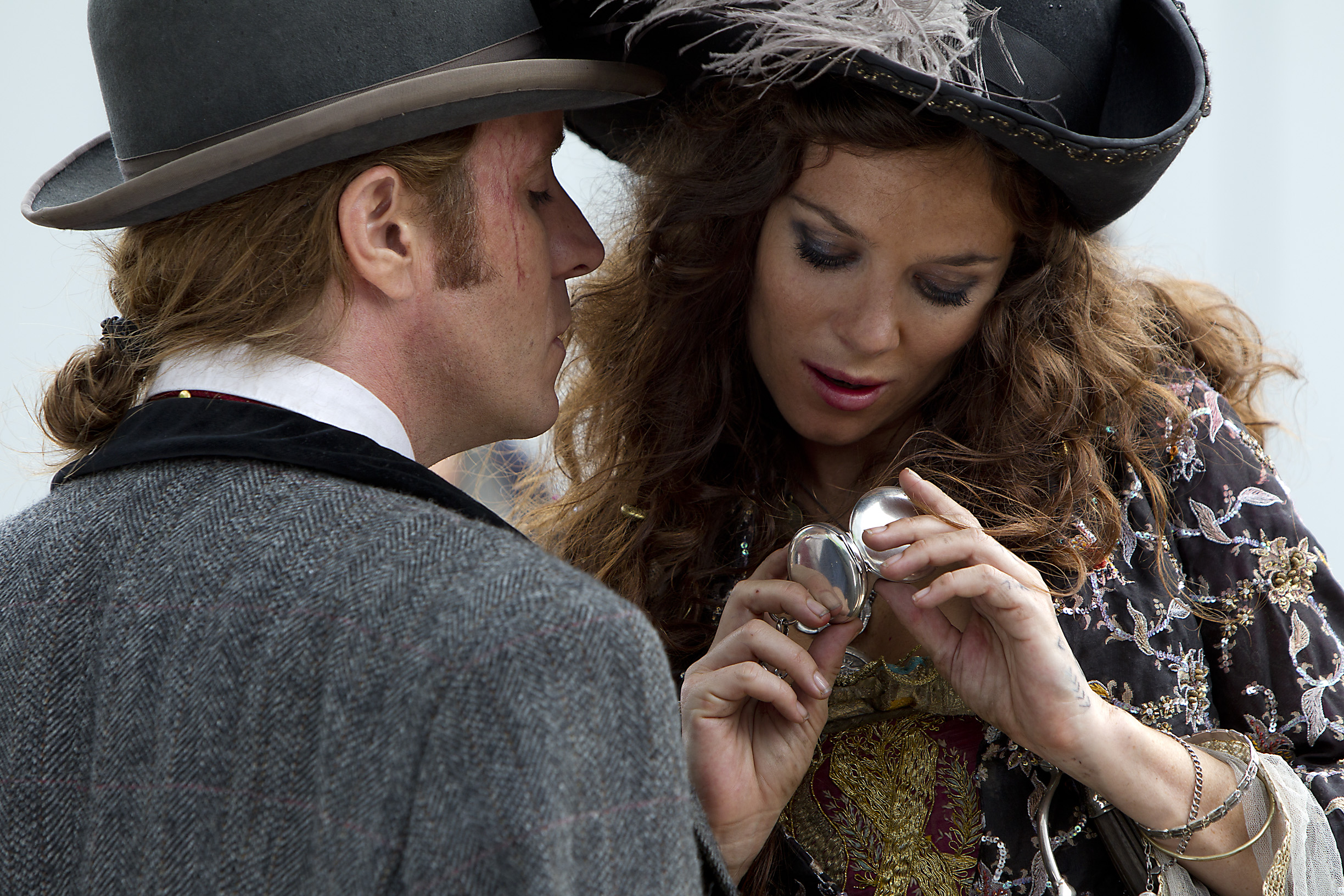
Note: Some of the images in this interview are behind the scenes photos from the making of London Boulevard. Thanks to William Monahan for letting me use them and for doing this interview.
Collider: A lot of people think that you directed an American film. In actuality, your movie is a British film.
 William Monahan: Yeah, it is a British film. It’s a very British film.
 Exactly. You have British actors. Can you talk about the fact that is has always been planned to come out in the U.K. first?
Monahan: We always planned to come out in the U.K. first – with Nigel Green at Entertainment- in the fall. Then, we would come out in America once Graham and Bob Berney’s new company, Film District, had been formed to operate in the U.S. domestically. I’ve done a little reading and Film District is not going to be one of these Picture House kind of companies, or like Warner Independent. They are aiming to distribute on a very large scale.
Monahan: They are. It’s very exciting, and it was well worth waiting for. You know, Bob Berney is kind of a genius at this. Jeanne Berney is great as well. It’s a very exciting new company. How far back did you hear rumblings of this company being formed and you going basically with a new company?
Monahan: As far back as I can remember. We were always going to go with Film District. Graham and I are partners on London Boulevard, and he said, well, we can sell this or wait for Film District, and I decided to wait. It was a matter of waiting for Film District to be put together. Many were thinking your film would end up at a festival this September. Did you want your film in a fest or was the plan to release it at the end of the year without festival buzz?
Monahan: I’ve never once had a film I worked on go to a festival, and I’ve honestly never heard anybody talk about festivals as what you do with a film. I think this is a case where you just put the film in the theater or the record in the shop. I don’t know the first thing about going to a festival with a film. I imagine I might learn one of these days but presently it’s outside my experience. Let’s talk a little bit about Graham King as a producer. I’ve interviewed Graham. Graham is a very smart guy and he seems like he is a really special producer. He really seems like he is artist friendly.
 Monahan: Yeah, he is. He gets it.
 Can you talk about his involvement with the picture? Was he one of these guys who is always around or was he one of these guys that once it’s all going he’s….
Monahan: He let me do what I was going to do. Graham is probably going to be one of the great independent producers along the lines of Sam Spiegel and Joseph E. Levine. I’ve learned a lot from working with Graham. Let’s talk a little bit about the editing process. Did you overshoot your movie? Can you talk about how you shot it and how challenging was it when you finally got into the editing room? Were you editing in your mind as you were on set?
Monahan: When I’m shooting, as much as writing, I see edited footage in my mind, so I work that way, and it’s economical. I just shot what I wanted and moved on. I shoot very little film. If you just do coverage you’re shooting any number of potential films instead of just one, and I was shooting just one specific film. Film is cheap but time is expensive.Clint Eastwood is famous for doing one take and moving on. Then, you have a David Fincher, who will shoot 99 takes.
Monahan: Well, I don’t move until an actor is happy, but it was very important to me as a so-called “first time director” to keep the machine moving. It was especially important to me to keep it moving and not be some kind of precious writer-director. That’s really the most important thing because you’re running an enterprise with two hundred-odd people, and it’s really your responsibility to keep it moving quickly. So you have to know what you’re doing, do it, and move on. Saying that, there’s always going to be a moment or a scene that you’ve rehearsed and that you’ve figured out in your brain. You have it together. You think you have it. You start filming it and you realize, “This shit is not working.” Did you have those moments on set at all and can you talk about one of those challenges you had to overcome while you were on set? Maybe some dialogue you had to rewrite?
Monahan: Nothing really went that way. Any improvisation on the floor was a pleasure because we had extra time or something. You could run out and give someone an additional line to try out, or something like that. I know now that the film comes together and transforms as you find the actors and the locations. Whatever you have in mind, going in, it all gets made when you’re looking through a finder on scout. Actors are players and if they’re hot, or onto something, you let them go, or you and the actor can both get on to something. I always run out with lines as I think of them.
What was it about London Boulevard that made you want to direct it?
Monahan: When I was a kid in London there was just something about the light and there’s something about the way London went onto film in those days, whether it was Technicolor or Technicolor plus the flatness of the light, or whatever. It’s mysterious and Elysian in a way that Antonioni got at in “Blow Up”. London exists normally in a state of bleach bypass. There’s the artistic context of “Blow Up” and “Performance” and all the Sixties and Seventies British films that I grew up on, because I did very much grow up on British films, and London matters to me because it’s the center of what I do for a living and has been since Tudor times. I write drama in the English language. If I wasn’t working in London I’d be doing something wrong. Ken Bruen’s book had a fantastic premise, which Ken knew I was going to follow in my own way, but it was the title that got me before I even opened the book. There’s an early days myth that we’ve done “Sunset Boulevard” in London but it isn’t remotely true. I’ve always been a bit repelled by “Sunset Boulevard”, which is wrong about almost everything it touches, whether it’s fame, Hollywood, screenwriters, or old ladies. Sunset Boulevard would only make sense to me if it was about John Gilbert and the pool boy. Norman Desmond would make sense. It’s a Fifties drag drama, and apart from a few good lines it’s written in a horrible Fifties patter, furthermore done by a German foreigner. Ken Bruen gave the plotline a good homage, but I didn’t do it. Ken did a Sunset Boulevard piss-take, but I went another way, mainly because the film star stuff, as it is today, is something that is known to me, I have co-workers and friends who live in a state of siege. When you become famous, everybody gets hurt. You, your family, the people you came up with who didn’t make it in quite the same way. I live in a state of partial siege and I’m only a fucking screenwriter. I wanted to do London Boulevard because I saw the potential of a story about two people who need each other desperately, who love at first sight, as one does, and above all a story in which no one is what they appear to be. Colin’s character, Mitch, never takes money from the actress— and he isn’t really South London—and he isn’t really a gangster. Everything that happened to him as a young man, as he says, happened when he was thinking about something else, and a lot of us can probably say that. I know that I can. When I was young I was only thinking of writing, and whatever was going on was unreal and comparatively unimportant. I was particularly anxious that I shoot the tires out of the class system. All it is these days is a hobby of certain masochists, and certain sadists. I figured out the class system in Massachusetts a while ago, and its one that makes England’s look like nothing. I had a guy at the Groucho bar a few weeks ago clawing at my arm nearly in tears saying that until he saw The Departed he thought Americans were the ones on TV. I didn’t know you had accents. I didn’t know you had a class system. I didn’t know you were like us. To which the answer is, probably only where I grew up, but while we’re at it don’t watch television and think it’s the United States of America.
Were you nervous about anything as you prepped the movie or does it seem incredibly familiar?
Monahan: There’s only one way to prep, so far as I know. You have your script, you hire the people you want, you find your locations and your setups, everybody shows up and you shoot the film. Even if I’d never seen it done before I’d have been all right, because it makes sense, but I’m also a guy whose first motion picture experience was seeing Ridley Scott glide past on a camera on a hundred and fifty million dollar film, and prep two movies, and there is no way to overstate that when you’ve worked with Ridley, it’s like having been a quarterdeck lieutenant to Lord Nelson. Then after that I was with Martin Scorsese, rehearsals, prep, and shooting. Then I was in Boston with Martin Campbell. Martin [Campbell] is very energetic and precise. He’ll on the set like four hours early with a flashlight and I thought, well, I’ll certainly try to be very neat about my script like Martin, which I wasn’t, but I’m not going to do that bit with the 4AM and the flashlight. I’d love to be able to say I was nervous, but I wasn’t. The only time I ever had anxiety it turned out to be asthma.What has the editing process been like?
Monahan: A learning experience on many levels, because it was the one part I’d never seen done, and it was a fascinating thing, but mainly it confirmed that I hate doing anything in offices. I either want to be out in the world or in my own environment—and it should be your own environment that you work in. After all, you’re not turning the picture over to a system or a process, you are the process, and the most important thing is to have things exactly as you want them. And I had that instinct but I didn’t know enough to say, hey, I want the Avid in Massachusetts. I went to dinner a few weeks ago in London with Anne Coates, who edited Lawrence of Arabia, and she said, “Oh yes, David had a flat just above the cutting rooms” and I thought, Jesus, of course he did. I could have made post a lot better for myself. We were constantly going back between Los Angeles and London over the last couple of months, when we got our UK date and went into high gear. I love editorial and sound and music, and I was working with the best people, so you learn a lot.
Was there a certain scene or scenes that you were always tweaking?
Monahan: I think probably everybody works most on the beginning and the ending. In this film, also, the beginning and the ending are both very stylized. We wrapped last year at this time, and we were always a fall picture, so I didn’t even really start to do my cut with any degree of seriousness until three months ago, when we actually did have a clock ticking. Whatever you cut when there’s no deadline isn’t really a cut. You’re just pushing colors around. Then when you finally know when you’ve got your release date, you cut the picture. I’m pretty humbled by the technical expertise of everyone involved, as much as I was humbled and impressed by the crew and departments during the shoot. As a director, you’re given a tremendous apparatus to work with, and very great talents are available to you. It’s all been terrific but I realized, to say it again, that I need as much of the business of making a film to be in my own workspace. It really ought to be a bit more like doing a novel, alone, at first. I’m feeling my way. When I was on set last year in London, you seemed like you had everything under control and the ship was sailing the exact way you wanted.
Monahan: Well, I’m not exactly Emily Dickinson peeking out through the curtains. As first time director, though, you’re like a new officer coming up to be in charge of very serious veterans, and you’re always going to have guys looking at each other for the first day until they realize you’re not screwing around. When they see you get what you want and move on, quickly, you’ve done a contract with the crew from that point. In Britain if the sparks call you Guv on day two, you never need an award of any other kind. You just have to know what you want and what you’re doing and it leads to a kind of general well-being, which I think you sensed when you were there. I had a genius cast and crew. My only real issue was getting up in the morning. I haven’t really had a job since I started getting paid for writing, and before that I wasn’t doing anything other than writing, either. I was always entirely about work, about getting where I am now. If I’m not working I’m thinking about it, though at some point I learned not to talk about it very much. Except now.What are your feelings on the test screening process?
 Monahan: Ninety people walked out of Goodfellas, which is what I think about test screenings. But they’re also irresistible, test screenings, because you want to see the film with an audience and watch the audience. We tested twice, and very well, for an R-Rated British film, in Sherman Oaks of all places. On The Departed, when we tested in Chicago, the audience wanted to know the same things the studio had been asking, on behalf of a projected audience—who’s the father of the baby, and what’s in the envelope. Marty’s position was: fuck you, this is art. This is the way Bill wrote it and it’s why I did the picture. I love audiences, but they’re not there to drive the bus. Whenever you ask opinions or anticipate opinions you can get pretty terrible art, or non-art. You need a single guiding intelligence, even in a collaborative form. People can get on exactly the same page, which I think we all were on London Boulevard, but it’s rare and difficult. Bands where every member exactly gets it, like the Stones to a certain point in history, are freak and magical occurrences. You’ve got to go it alone.
 Obviously, you’re known as a very famous screenwriter. Your screenplays are quite good and you have a British cast that, I’m imagining, are very respectful of the words and of the screenplay. Were they a little bit intimidated in changing lines or were you encouraging them all the time? How precious are you with the commas?
Monahan: I’m not very precious at all, which I think people find surprising. Or maybe I should say that you evolve in the ways in which you are precious. When you are the director, you are also continuing to write on the floor as you go along. Saying directors don’t write because they don’t type is very wrong, it’s like saying Dylan doesn’t write music because he doesn’t write notation. On the other hand if you decide to do Hamlet in a funny hat staged in a ruined factory, it doesn’t make you Shakespeare. For some reason, I seem to work well with actors. I love working with them. The thing about movies is if somebody has an idea that works, it’s in, and I say that as a screenwriter as well as a director. Ray Winstone came up with a couple of spectacular pieces of rhyming slang that I never would’ve thought of even though I know rhyming slang. I’m not a precious text protector, or anything like that, you know, because it’s a much more vital form than that. You have to rock. If you change a location opportunistically, to gain a day on the schedule, which I did more than once, you have to re-rig everything creatively on the spot, and you not only have to be able to do that, but do it with great fluency to keep moving. I used to go apeshit when anything got changed in a film but you live and learn, and I have learned.
Let’s talk about the film stock. You obviously chose to do film. Was there a lot of debate in your brain between film and digital? Or was it always going to be film?
Monahan: Film. I wanted a look that was kind of like the 1960’s and 70’s British Technicolor films I grew up on. So there’s an edge of that sort of retro look to the film Digital was only used in Los Angeles for contrast. We shot a bit of digital on the Los Angeles shoot, to give it a different look from the London stuff. Let’s talk about the music and score of the movie. I have not seen the film yet and I haven’t heard it yet. Obviously, every aspect of the movie, from the way it’s shot, to the music, to the editing – it all plays a huge part in it. How early on did you know what you wanted for the score?
Monahan: I had got to a point where I was going to go with rock and roll source, but one day Anna Friel and David Thewlis were at my house, and Anna said, “I just heard this new song by Sergio Pizzorno. You’ve got to hear it.” Serge had been up in San Francisco recording and by chance Kasabian’s manager was there at my house with his laptop, during this sort of extended party, with Serge’s “La Fee Vert” on it. So I stuck the plugs in my ears and I was hearing this brand new song, and I looked up across the litter of wine glasses, and said to David Thewlis, “Jesus, it’s London Boulevard. It sounds like the inside of my head.” I was considering writing music for the film myself, because I do that, but it never got together. As soon as I heard Serge’s “Green Fairy”, all bets were off, even if I had composed anything. It was him or nothing, so I got him in, met him at my house in Massachusetts, and he scored the film at British Grove and Abbey Road, and he killed it. He’s a born film composer. His level of preparedness is something that I can only compare to my own when Ridley Scott said to me, “Do you know anything about knights?” [laughs] When you get the nod, be ready. I definitely want to know about your writing process. I’m sure that a lot of screenwriters, and would-be screenwriters, are curious. You clearly have a knack for screenwriting. Are you one of these 9-to-5 guys or I’ve spoken to some screenwriters who talk about the “golden period”, where they have four hours a day where they are really eloquent, and the rest is just putting their head to the page.
 Monahan: Well, you can have any number of four hours within a single day. When I was a kid, I read that Sir Richard Francis Burton, who was a very productive writer, had a room with six desks in it, and I always remembered that. So you can sit at one desk and do your four hours, you know, then wander off and play with the kids for a little bit. Then, you can go to your other desk and do another four hours. Then, it’s like a brand new day’s work. Then, you can move to your other desk and do another four hours. So you end up doing twelve hours without even noticing it. Unless I had learned how to do that, I couldn’t possibly maintain my schedule these days. It’s all a matter of moving to a new desk and starting a new day, within the same day.
You’re actually sort of opening the door and I definitely have to ask: While you were writing, directing, and making this movie, I continually read your name attached to many different things. How in the hell do you have the time to do all of this different stuff?
Monahan: Pretty much by not doing anything else. Even while we were shooting, I was able to do my four hours a day. It was physically exhausting at first for me to shoot. My job has been, for the last ten years, sort of sitting on my ass in hotels writing things. Then, all of a sudden, the car is outside at 6 A.M. dragging you off to tramp through fields in East Sussex looking for camera positions. It was a couple of weeks before I actually got up to speed on that I was sort of winded for a while. I didn’t have the right clothes. I ended up all North Faced out. I suppose I must be a director now. I have rain gear and an Arri jacket. The night we were shooting the scene where Colin and Ray go nose to nose I was sick, and started ripping layers off because I thought I was hot, and Chris Menges said “Put your coat back on. You’ve got fever.” Knowing you were going to direct London Boulevard, did that change the way you wrote the script?
 Monahan: Yeah, it meant I was carrying some of the film in my head, because I could. But I always write as I like to write, and I’ve been thinking about it because I honestly didn’t realize how different my stuff is, until I started looking at other people’s scripts as a producer. I thought, Jesus, no wonder I’m working. When I started writing screenplays, as early as I started writing anything, I hadn’t seen any ordinary screenplays. I saw movies and figured out how I thought they should be written. The only one I had seen was Dylan Thomas’ The Doctor and the Devils, which I found in the house when I was twelve or something—and that was my only reference. By the time someone gave me some samples of standard screenplays I was already beyond that stuff, because I was not only a tinkerer in ways to do things, I’d started from Dylan Thomas. As a screen dramatist he was a very intense visualist, with great timing and fluency. That timing and fluency, inherently, is camera direction, direction of the imagination, of the eye, or, to be more accurate, a representation of edited film. If you see, as I do, in edited film, you’re going to end up as a director. Anyway, I came into screenwriting from an odd direction, because the first screenplay that I read was and is better as writing than the top one percent of literary novels. So I never viewed screen drama as a vulgar form, or a lesser one, and I’ve never written it left-handed. Novelists who get shitty about screenwriting invariably can’t do it, or they can’t hack it in the world of what’s really, in truth, very bold and very public enterprise. People tell you no no no, don’t write like a director, but the truth is that you fucking well should write like a director, because any real director won’t mind, and he’ll do his own thing anyway. The old days of screenwriting, and myths about screenwriting, are maybe over. It’s a literary form, if you can wake up to it. Even though a screenplay is performed only once, unlike other forms of drama, it’s still a performance in itself, and unless it’s a great performance, odds are that actors will not come, and a movie will never be made.
 You mention the “script as a performance in itself”. It seems that more and more script reviews are popping up online. Do you think it’s fair to review a script of a movie in production or about to go into production when things change so much on a day-to-day basis?
 Monahan: I don’t like scripts leaking. On the other hand, the more real attention a script gets, the better. In reviewing films, people get quite liberal about saying “the script” this and “the script” that, when they’ve never read the script any more than they’ve read the latest report on Norwegian herring landings. I don’t think Roger Ebert has ever mentioned a screenplay. He assigns every auctorial move to the director, which makes some sense since the director has run a one-off game, but if Hamlet were written last year and had been only performed once as a film, and it didn’t come off well on screen for whatever reason, it would be gone forever as a literary work, and never would have been considered as one. I think that scripts should be published, but they are published, really, because when you’re a screenwriter, your stuff ends up in samizdat form on thousands and thousands of desks and shelves across the industry. If you write a screenplay that gets circulated, you have a bigger readership than any literary novelist. And it’s an educated audience as well. Some reviewer might be out there saying, obviously Edge of Darkness didn’t come off because of the script, blah blah blah, but everybody has read the script, except the journalist attacking it.
After making this film in this genre, are you anxious to explore any other genres? Or are you comfortable in this one?
Monahan: In all honesty a gangster picture was the easiest kind of film for me to get made because of The Departed, , but I wasn’t going to do anything in Boston. I had to go to Europe and work very visually. I think that next I want to do something historical or at least period. That’s actually really good because I know you’re a man of history. One of my favorite films from the past ten years is
Kingdom of Heaven: The Directors Cut, which I think is a phenomenal film. One of the reasons is because it has that realistic feeling. Hearing that you want to tackle something in history is exciting to me as a film fan.
 Monahan: Well, I don’t quite know what I’m going to do next. It’s the sort of usual case where the directors end up multi-attached to everything in the world, except I don’t announce it. So it could be any number of things. Quentin and I have something called The Gamblers, which is set in the late 50’s, 60’s, and 70’s in England. There are several things. Becket is in play, from the Jean Anouilh play, which was previously made into a film with Peter O’Toole and Richard Burton, but I’d do something else with it.
 What is it about the British gangster movie that is so popular around the world?
Monahan: It’s hard to say. I was just watching Get Carter again last night. I put it on Apple TV and watched it again all the way through. I just meant to look at one particular scene and I ended up watching it all the way through. It’s just astonishingly good. Get Carter is a classic, but it did nothing in the United States. It came out on a double bill with a Frank Sinatra western. It wasn’t just British gangster films that really did for me as a kid, personally, it was British films in general.When I was growing up, there was a UHF station in Providence, Rhode Island, back in the days when you had to put aluminum foil all over the rabbit ears to get a signal. Those were days when you would get the TV listings from The Globe and The Herald. Video was out, but nobody could afford it…expect for my uncle George, who was a second father to me, and had every film in the world, and every book. He’s probably why I’m here, him and my Dad, who at one point said “I don’t know what you’re doing but I think that you do, so I’m going to help you.” And the fucker put me on an allowance so I could write. Anyway, when I was very young, you would get the TV listings from The Globe and The Herald, and you would basically go through them, circle things, and map out your viewing week. And if Bedazzled was on at 3 o’clock in the morning from Providence, you would be there taping up the rabbit ears, and putting a tape recorder down so you could get Peter Cook’s dialogue even if you couldn’t get the picture. There was some strange anglophile fucker operating out of Providence, who just played everything that you needed, all these films of the British New Wave, and I was like a kid in England in the fifties hearing Chuck Berry for the first time, getting exposed to this stuff I needed to know, to do what I had to do. You needed British art to figure out Boston, because we were the lost world as far as American popular art was concerned. There was no American mirror to what we were. New England practically hadn’t been in American art in any way since Concord, or William Dean Howells, and TV seemed like it came from fucking Mars. Then Python hit, and the 60s and 70s British pictures started coming in on UHF, and that was our world and our humor, and that was the way forward. You’d get The Loneliness of the Long Distance Runner or Billy Liar or Saturday Night and Sunday Morning or Darling or The Servant or The Ipcress File on TV at four in the morning, and it was like listening to Radio Caroline, and so was finding Joe Orton, and John Osbourne, Pinter and Stoppard and people like that. I learned my job from English dramatists. Tennessee Williams was no good for me, New York stuff was no good to me. If you want to learn to make a samurai sword you go to Japan, if you want to know drama in English, you look to England, and it’s that fuckin’ simple. The thing about The Departed, the x-factor that people can’t quite put their finger on, is that it deals clearly with class and accent all these things that are fundamental to Boston, but previously anomalous or even prohibited in demotic American films. Without English art, I never would have understood myself, my own family, or the New England world I lived in, as it was at that time. The Departed is the first time Boston was ever put accurately on screen, and I’m intentionally excluding the Friends of Eddie Coyle, which incidentally had an English director, because Higgins did a sort of Amos and Andy dialect comedy about his own people to entertain an audience of wannabe WASPS. Higgins had an investment in trashing his own people to entertain cunts who thought the Irish were fucking animals, with the possible exception of George V. Higgins. I’m more from a double world where I wasn’t part of anything or invested in anything, because I was Irish, and very Irish, but also the other part of my family, not that it had airs, or money, was descended from the first minister on Cape Ann in the 1620s. So in Boston terms I was everyone and no one, with no social investment, no social insecurity, sort of Imitation of Christ in one hand and The Education of Henry Adams in the other, and because I was part of nothing I could observe everything without having anything personal invested in the findings. I was born in 1960 and there were still sadistic old ladies, pretend Yankees with their fucking hats pinned on, born in the previous century, who would treat you like a cute little Papist, even after Kennedy was president. And I was a mick but I was also more them than they were. Anyway to get back to The Departed, the fact is you could move The Departed to the North of England, without any problem whatsoever, but you could never, ever, move it to Texas, or Chicago, or New York, and that tells you something about England and New England, and maybe why I can work in England, apart from a pretty stiff education in English drama. Henry Adams was scared shitless, politically, by the discovery that England isn’t alien to a boy from Boston, but it was true, and it is true. It’s a Boston and coastal Massachusetts thing. Henry Adams blocked it out. T.S. Eliot, who learned to swim at the same beach as I did, just threw in the towel and moved to Cheyne Walk. I’m not going to do that but I’m not scared of the open channel between me and Britain. It was a lifeline. It’s not the old days of Mencken or Hemingway and the “American Language” thing which was always nationalistic, Anglophobic, and often pro-German bullshit. I can work in London. A British journalist asked me if I had any trouble working with an English crew, as an American, and I said I might have if I was from Scotland, but I’m from Massachusetts, which is sort of Oxfordshire, but more intellectual. That’s kind of unforgivable but you’ve got to let them have it.
You talk about watching these movies as a kid, and low and behold, your first time behind the camera is in England, with English actors, telling an English story. Do you think those memories as a kid had something to do with you always being on the path of making this movie?
Monahan: The first time I ever thought about doing a film seriously, I was in London. I was about 17 years old. I was just standing in the street, a bit dazzled by an Antonioni bus wipe, which by the way are inherent in London, and I imagined a film set in London starting out with the riff from The Yardbird’s “Heart Full of Soul”, and now, how ever many years later, I’ve done it, because that’s how the film starts out.That’s actually very cool.
Monahan: It’s very much a full circle thing. I’ve done a lot of things I intended to do at this point. Saying that, you’ve obviously been on a lot of sets. I would imagine that you’ve seen a very talented directors place cameras in certain place and maybe you are standing there as outsider and thinking, “Shit. I would like to put the camera slightly to the left.” Were you making those mental notes while on all of the sets that you’ve been on? Sort of waiting to the day that you would finally be in that kind of a position?
Monahan: Well, you can’t help but make mental notes, but I would never second guess Ridley or Marty if that’s what you’re saying. They do what they do and I think about what I want to do and it’s two separate things. If there’s anything that distinguishes my screenwriting at this point, it’s the fact that it’s very visual. It’s the first thing that Ridley Scott said to me. In fact, he held up the script to Tripoli and said, “It’s very visual, isn’t it?” Then, when I was in London we pulled off a steady cam shot in the pissing rain on Kennington Road one night, and I’d been working so hard making the film that I hadn’t even emotionally processed the fact that I was a director. That I’d got from there to here. All of a sudden I pulled up short and harked back to Ridley holding up the script in Manhattan, at the St. Regis breakfast room, and saying, “It’s very visual, isn’t it,” and realized it was the key to my whole life since then. My gratitude to Ridley isn’t anything new. I named one of my kids after him five years ago. But he’s a very important person to me. Tripoli
 is one of those films that I’ve heard about for awhile. Obviously, the script is done. Do you have a lot of those kind of scripts that are sort of there, that you are proud of, and that you want to see made? Are there screenplays that you’ve written for Ridley, or other people, that you envision yourself ever getting behind the camera and doing those yourself?
Monahan: Yeah. I mean, I’ve thought about Tripoli from time to time. I asked Ridley about it at one point, and he sort of gave me his blessing to go on with it if I could, but I haven’t really done anything seriously about it. The ownership is complicated because I own the original script, which is the best one, as well as the underlying rights, and Fox owns the so called sterile drafts, and Mark Gordon is still attached as a producer on it because of some paperwork situation. People are still doing deals by claiming to control Tripoli, when I control Tripoli. I mean, maybe they literally don’t know that I own it. I reread it Tripoli again recently, and it sort of stands on its own as a piece of writing. I was actually quite proud of it when I read it again. I wrote it in 1993, you know, and stuck it in a drawer until almost 2000, and it’s still the best script out there by a very long distance. I would direct it in a minute, and personally believe there’s a bit of a market for showing the USS Constitution opening fire on Tripoli. I’ve talked about it with different stars, so has Ridley, so has Graham, and everybody wants to do it and nobody does anything. I’ll just publish it one of these days and forget it. Blood Meridian is one of the best scripts I have ever done, and that hasn’t been made. There’s a problem because it’s very violent, and no one can quite understand that Glanton is the hero and the boy is the observer, as in more than one Western, not least Shane. Also, no one can understand that the story takes place in Catholic Mexico, rather than the American West. Steve Tesich’s screenplay actually had a wagon with “Manifest Destiny” painted on it. I couldn’t believe it. It seems like Hollywood right now is moving in two directions right now. There’s the budget that is around $35 million dollars. Then, there is the megabudget tentpoles that are now being released all times during the year. It seems like the midrange between there is going away…
Monahan: I’ll tell you, I think 35 is actually a little high. 
I could be wrong.
Monahan: Well, what I’m saying is that it is high for me. You know, not for general purposes. I don’t think you need $35 million bucks to make a movie. I think what people should do is make a lot more movies for a lot less money. You can really do it. I think London Boulevard was 28, and it looks like a lot more than that. I was shocked to learn that you were going to be working with Joe on
Oblivion. I had no idea that you were such a sci-fi guy. What were the sci-fi films that you grew up with because when people think of you, they don’t immediately think, “sci-fi guy.”
Monahan: The trouble in this business is that people assume that what you do is whatever you did last. For a while, even with Kingdom of Heaven in front of me, and Tripoli, which is in Regency language and set in 1804, all anybody was offering me were R-rated contemporary things where men with guns swear at each other, and hit each other. But that’s a packaging thing because The Departed was so successful. If you can say I’ve got this book where alpha males hit each other and I’ve got Monahan. you’ve got a deal, so that’s how all that happens, but I had a long writing history behind me before I got into anything in film. It comprehended science fiction, it comprehended historical, it comprehended, you know, just about everything that you can think of. I have a lot of stuff that I never published because I always had a sense that novels were not finally going to be the way I made my living, because the form was dying commercially. I’m interested in stories about human beings. I don’t care where or when they are set. I write women quite well and you wouldn’t know that, either.It seems to me that you’re either a
Star Wars person or a
Star Trek person. I don’t meet many people that claim to be both. So which one are you?
 Monahan: I’m kind of both. Well, it’s like The Beatles and The Rolling Stones. The only answer to “Are you Beatles or Stones?” is, “I’m both.” Star Wars was great at the beginning and crap at the end while Star Trek has always been interesting, and the difference is in the writing, and the thematic intentions. I don’t think the latest Star Wars pictures have any artistic intentions, but the original picture opened up epic science fiction.
Let’s say if you had the choice to watch any of the
Star Wars movies or any of the
Star Trek movies. Which movie do you pop on?
Monahan: Out of all of the Star Trek movies? I happen to like the most recent one the best. I think it was the best one ever done. I think it’s an amazing film. I really do. Speaking of other projects you are writing, what was it about
Oblivion that attracted you to say, “I’m going to devote my time to this.” I would imagine that you’re in the unique position that you are being offered a lot of things to work on. Obviously, your time is valuable. You are making movies and you are writing stuff. What is your criteria for picking a project that you want to be involved with?
Monahan: Joe has laid out as I have said, a story that has a chance to be one of the very greatest science fiction stories ever, basically a story about identity, but also very commercial, and it was irresistible. Oblivion is basically asking the essential Greek questions. You know, “Who are we? What are we? Why are we here? What are we doing? Where are we going?” Joe came to me with the template for this gorgeous film about identity and appearances. The difference between what is and what seems to be is the only turf for a writer, and Joe’s film has that in spades. 
Joe has a very visual style. I’ve seen it now with
Tron: Legacy. You’ve even quoted the fact that Ridley calls you a very visual writer. So is this one of these perfect marriages?
Monahan: My job as I see it has been to more or less come in, and do the fights and the dialogue. He really has previsualized this entire world, there’s a lot of art, and this is one case where I am coming in after the existing material without any intention to alter it significantly. I just want to add my bit to something already conceptually great. Over the last year, you’ve been writing other things. Are there projects that you’ve been working that maybe people will be happy to learn about? Or has it just been pretty much
London Boulevard.?
Monahan: I think I’ve written three redrafts or something while in post-production, and two more specs, but I wasn’t able to contractually start anything, because I won’t sign a contract if there’s a chance I might be pulled off the job by something else. With London Boulevard post, as I said, until you know your date, you’re basically pushing colors around and experimenting with music and sound. And then when you get your date, you seriously go into post-production, which for us was like two and a half months. Was working in post a nine in the morning until nine at night thing for you?
Monahan: Not at all. [laughs] Or not until the end. I haven’t continuously been working on the film since last fall. I mean, our situation was that we had to wait for the release cycle to tick around again. Like I said, we wrapped here, in this building [the Chateau Marmont], at this time last year. We were never coming out before November in Britain anyway. So we had to wait. I never work until I have a deadline these days. You have to fit so much in a given day that you just don’t get serious until you know when the deadline is. If you’re playing around with a film, you’re just playing around with it. But if it has to go into theaters, you get yourself into gear and finish it, which we did in very short order on London Boulevard, shuttling back and forth between London where we did ADR and VFX and Los Angeles where we did the edit and the mix. Whether or not that was the best arrangement is something to think about.
This being your first film, can you talk about your initial meetings when you first started the casting process. Could you talk about the people you ended up getting? Were these all of your first choices? Can you talk about your initial meetings with Colin or Keira? Was there a little bit of nervousness with you, like “Shit. I really want to get Colin. Is this going to happen?”
Monahan: Well, casting is all about availability, as much as anything else. The thing about a film is that 200 people have to be all available at once, and the check has to be in the bank. There is scheduling stuff involved. So when I wrote it, I had no idea of casting whatsoever. I mean, I never write with particular actors in mind. I met Colin over at the Roosevelt one day. I just went to see him at the Roosevelt and met, with Graham, and I thought, “Yeah. You’re Mitch. Let’s go.”Did you tell him that at the meeting?
Monahan: Yeah. Well, in not so many words. I just said, “I’m cool.” But he’s…I think he is a fantastic actor. He is an absolutely fantastic actor, and I can’t imagine the film with anybody else now I was just watching him today, and he’s so fantastic. I sound like Warhol but only because I’m tired.Had you seen
In Bruges before meeting with him?
 Monahan: Actually, no. I don’t watch anything. I work so much these days. If I see a film, it’s usually that I’ll go in after working 15 hours and slam in The Bridge on the River Kwai or something. So I often don’t keep absolutely current with films. I’m too busy making the fucking things. I saw In Bruges in a hotel. I hadn’t seen In Bruges before I cast him in this, but I’ve seen him in everything else. And the important thing is seeing him sitting there, and knowing for an absolute fact that he’ll not only be Mitch, but be the best Mitch in the universe. Colin I have always loved as an actor, I love him now as one of the finest and kindest men I’ve ever met, which he truly is, he has a great soul, and I’ve never ever seen him better than he is in London Boulevard. Keira is terrific in the film. I can’t imagine the film without Colin or Keira now, but I wrote London Boulevard as a spec off a book I’d bought with Quentin Curtis, with no absolute idea I’d really have the chance to cast or direct it, though I hoped or thought I might. You don’t write for actors. Actors come for characters you’ve made up. I always knew that David Thewlis would be Jordan unless there was some scheduling misfortune, because I asked him, at my house, just after I’d finished the script, and he said he would do it if he could. I hoped that Ray Winstone could be in, and Anna Friel, if she was available, but casting is always subject to availabilities, and I got lucky. I not only have Colin and Keira, but one of the best British casts anyone’s ever heard of. Because we’ve been a bit under wraps, you’ll say I’ve done a film, and people ask vaguely “Who’s in it,” and you say, “Ah, Keira Knightley, Colin Farrell, Ray Winstone, David Thewlis, Anna Friel, Ben Chaplin, Eddie Marsan, Sanjeev Bhaskar, Matt King….” And by that point, especially in Britain, they’re choking. Matt King, who’s a genius, isn’t in as much as I’d like, but want to do something else with him soon. There’s a guy named Tim Plester who plays a paparazzo, who you’re going to hear a lot about. He’s in a little part, but he’s a great new actor. Ophelia Lovibond is great, with a great future, and she has a Sixties thing going on which I was looking for, for this film. Anna Friel is remarkable. She just lights up the screen and is ridiculously talented.
Once you have that reaction as with Colin and you are sitting there, how nervous are you at that moment of “Shit. I got the guy.”, and that it could fall apart. Or was it always like, “Oh. This is going to work out.”?
Monahan: Well, on an artistic level, I knew it was going to work out immediately. The deal part, I have nothing to do with. That’s all Graham. I think we did get pushed from winter shoot to summer and early fall because of someone’s availability, which had consequences for our release, but I forget whether it was Colin or Keira we had to wait for. When I met Keira, we were actually on scout. I think we were already deep into scout and I met Keira. We met at some hotel near Paddington, I think. I met her and she was wearing a cardigan, and she had her sleeves pulled down over her hands, and I thought “Great. Ok. Let’s go. Your character wears cardigans. See you in June.” What’s interesting is that her character in the film is plagued by paparazzi. When you went to go meet with her, did she have the paparazzi following her?
Monahan: Not that day, no. At other times, it was a definite concern. She had a lot of insights into the condition of her character, which made it into the film.I was actually going to ask you about that. The fact that there are so many newspapers and paparazzi now. They want to capture actors and actresses on set in costume because it sells. At the same time, as a director, I’m sure you want to keep as much hidden to protect the story and plot. How was it like for you dealing with the paparazzi?
 Monahan: We only had one day where paparazzi and crowds got really bad, and it coincided with the only crisis on the shoot. We were on Holland Park Avenue, and I arrived at the chemist we were supposed to shoot in, and there were supposed to be transparencies of Keira’s character all over the chemist shop, and there weren’t. There were supposed to be at least thirty transparencies of the David Bailey photograph. So out of the side of my mouth I said to Huw from the art department, “How many guys from the art department are here?” and he said, “Well…just me.” And I said, “Well, get everybody.” So we had this trouble inside the chemist shop, scrambling for the transparencies—I still don’t know who dropped the ball on this one, because the art department was blindsided—and meanwhile the paparazzi were gathering in the street. So we actually had to pull off the inside of the chemist’s and do the shot outside in the street with basically one steadycam shot each. Two shots. And we did it. And had an early wrap. We also had a bad night with the paps when Colin was driving the Silver Cloud, which is the same one as in Blow-Up, incidentally, on Holland Park Avenue. Guys with cameras were running through traffic, just anteloping for blocks to try to catch us when we turned around the camera truck. I thought someone was going to get killed, but there was nothing we could do about it. These jackasses have to do what they have to do.
 You have a great supporting cast. With that kind of cast, was it a casting director? Or was it you saying, “Ray Winstone is going to be great here.”
 Monahan: Ray is a friend of mine, and so are David and Anna and Ben Chaplin. There’s a weird coincidence that they’re also the perfect cast. So there was no fumbling around for cast. I wanted David and Anna Friel from the beginning. David was the first person I ever talked to about the movie. I always knew that he would be Jordan if his schedule would allow it. Basically, that part was cast in my house I think. I hoped Ray would be in if his schedule would allow it. You know, everybody else turned up. It was really good. I think we have the best British cast I’ve ever seen. Ben Chaplin just kicks it apart. He is so good in this movie. Ray is great, as Ray always is. Eddie Marsan is in it. He’s fantastic. There’s nobody that didn’t turn up for us. We had a great casting director, Nina Gold, who has previously cast stuff I’ve written, not directed, but she knew my stuff. We set up shop at the Groucho Club to see people, and then later moved over to Ealing Studios, where I think I broke the record for cigarette smoking, no matter what was going on there in the Forties.
I wanted to ask you about “tone”. How is the film’s tone like in terms of comedy versus drama?
 Monahan: It’s always a mix of everything. If you watch Kingdom of Heaven, there are some funny bits in it. The Departed’s funny. I think the only real referent for anybody writing drama is probably Hamlet. You have the most extreme tragic drama, this sort of blood-boltered thing, but it’s also very funny, which is simply a matter of the playwright being alive and observant and entertaining, and understanding not only the world but what will play. while the interview ended with the above answer, I recently spoke to Monahan and asked him…
It just came out that you’re going to do
Becket. Do you envision this as your next film or could another project happen before this one?
Monahan: I’m going to scout for Becket very soon, maybe very much earlier than I even anticipated. I learned a very great deal on London Boulevard and there’s a terrific core group of people who want to work on something again. I’ve been chomping at the bit for a year to get on to something because we all had a really good time together and it’s addictive. I hope that London Boulevard justifies everybody’s hard work. You never know what people are going to go and see, but ten days from now in the UK, we’ll see what happens with London Boulevard.http://www.collider.com/2010/11/17/william-monahan-interview-london-boulevard/


 http://collider.com/hunger-games-piranha-3dd-gravity-set-photos/95795/